6 teaching weeks
£705
Full rate
Half a term. One paper, or one habit that is costing marks, taken apart and rebuilt.
1:1 online · all major exam boards
One-to-one Spanish tutoring for GCSE and A-Level, taught live online. The reformed GCSE papers — dictation, read-aloud and the set vocabulary list — and the full A-Level course including the speaking exam.
Taught by Leah Burgess, who read French and Spanish at St Edmund Hall, Oxford, and has taught in schools across Europe. Teaching is sold in blocks of 6, 12 or 24 teaching weeks.
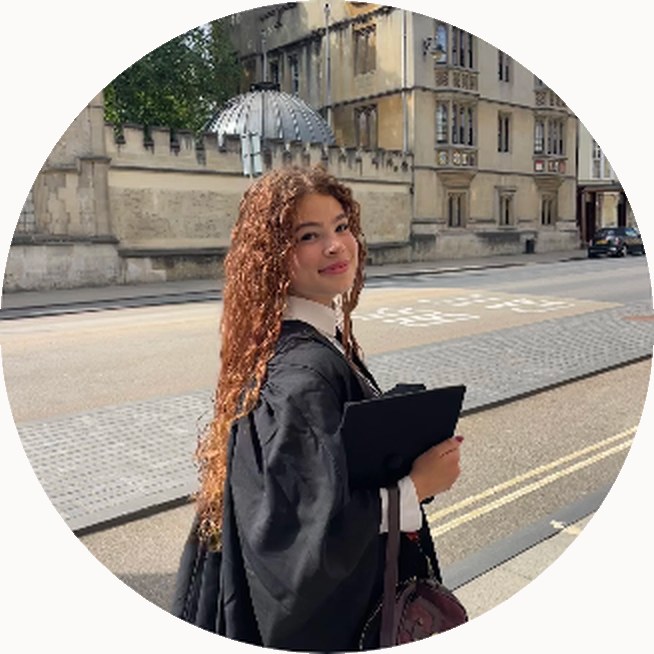
Mrs Leah Burgess. French & Spanish, St Edmund Hall, Oxford. Seven years and more of one-to-one teaching.
Our expertise
AQA, Pearson Edexcel, Eduqas, OCR and Cambridge Assessment International Education are the owners of their respective names and marks. They are shown here to say which specifications are taught. The Russet Collective is not affiliated with, approved by or endorsed by any awarding body.
GCSE · ages 11 to 16
The reformed GCSE Spanish specifications were first taught in September 2024 and first sat in summer 2026. Anybody sitting them in 2027 is in the second cohort ever, and a great many of the people preparing them have never marked a real paper. Four things changed, and each rewards a different habit.
Sentences read three times — whole, in sections, then whole again — and written down, with a small number of words deliberately from outside the vocabulary list. It tests the join between the sound of Spanish and its spelling, which is exactly what gets skipped when a class is taught to recognise words on a page. It cannot be crammed and it improves steadily with weekly practice.
The speaking test now opens with reading a short passage out loud, then answering questions on it. A candidate who has only ever spoken from memorised material meets unfamiliar Spanish in print for the first time in the examination room. Reading aloud weekly, to somebody who corrects the pronunciation as it happens, is the whole preparation — and almost nobody does it.
The examinable vocabulary is defined and published, with a handful of words placed deliberately outside it. Revision stops being open-ended word-learning and becomes a finite list to be genuinely known, plus a strategy for the words that are meant to be unfamiliar. Knowing which is which is most of the work.
Accuracy is rewarded over ambition. A simple sentence that is right beats a complicated one that is nearly right, and the drilled habit of forcing in a subjunctive to impress an examiner now costs marks. This is the change that most surprises strong students and the easiest to fix once somebody points at it.
The date that catches families out
The speaking examination is not in May. It sits in a window of up to five weeks during April and May, and the school chooses its own day inside it — so it is the first thing your child sits, and it is the piece that rewards months of steady practice. Revision plans built backwards from the written papers arrive at it three weeks late, every year. The full calendar is here.
Summer 2027
Series-level dates from JCQ, the same for every board. Individual paper dates are not published here: they differ by board, several 2027 timetables are still marked provisional, and a wrong paper date is worse than none.
Summer 2027, series-level dates only. Paper dates differ by board: AQA · Pearson Edexcel · Eduqas. The full calendar.
Boards taught
AQA (8692), Pearson Edexcel, Eduqas, OCR and Cambridge IGCSE Spanish. The reform is common to the domestic boards; the vocabulary lists, the tiering and the exact form of each task are not, and Cambridge IGCSE sits outside the reform altogether with a structure of its own. Put the board on the application and the teaching is set to it from the first session.
A-Level · ages 16 to 18
This is where students who coasted through GCSE on vocabulary come unstuck. A-Level Spanish asks for critical essays on a novel and a film, an argued position on social and political themes, and a spoken defence of research the candidate chose themselves. The language is the medium; the marks are for the argument.
Paper 1
Broadcast and journalistic material at native speed, comprehension across registers, and translation in both directions. Translation into Spanish is where accuracy is worth the most and where a term of drilling shows immediately.
Paper 2
Essays in Spanish on two studied works — two texts, or a text and a film such as Volver or El laberinto del fauno. Marked as literary criticism, not as a language exercise, and this is the paper where an Oxford-trained reader is worth the most.
Paper 3
A discussion from a stimulus card, then a presentation and defence of an independent research project the student chose. It is not written coursework — it is spoken, and it is examined by being argued with.
The independent research project
A subject too broad to hold, or one with no argument in it, produces a presentation that cannot survive its first follow-up question. Picking a project narrow enough to defend, and rehearsing the questions an examiner will actually ask, is one of the highest-return pieces of work on the whole course — and it is done here in Spanish, out loud, with somebody pushing back.
Essays are written in Spanish and marked in Spanish, in the margin, while you watch.
Boards taught
AQA (7692), Pearson Edexcel and Eduqas. The prescribed lists of texts and films differ, Edexcel and AQA weight the speaking component differently, and the research project is framed differently on each — so the board is confirmed before a work is chosen.
How a session happens
Distance learning usually means a face in a box and a shared document nobody is writing on. This does not. Leah shares her screen at full clarity and works on an iPad while you watch: the work is on the screen, and her pencil is moving across it in real time.
A student sees the sentence being crossed out, the arrow being drawn, the word being changed and the reason being written in the margin, in pencil, at the moment it happens — and can argue with any of it while the pencil is still on the page. It is the nearest thing to sitting beside somebody at the same desk, and for a good many students it is better, because the writing is the size of a screen rather than the size of a page.
Live pencil annotation, on a shared iPad
Handwriting, arrows, underlining and marginal notes, drawn while you watch — in pencil for anything that is a judgement, and in highlighter where a passage needs picking out. Pencil on purpose: a mark in ink is a verdict, and a mark in pencil is a suggestion a student is invited to argue with.
Clear screen, clear sound
Text is shared at full resolution rather than as a blurred video feed, and the audio is good enough to hear an accent properly — which for a language lesson is not a nicety.
Practice set every week, and marked by hand
Questions chosen against the paper your child sits next, not against the syllabus in order. Leah marks them herself and returns them, so the next session starts from what actually went wrong rather than from where the textbook happens to be.
Nothing to install, and no travel
A browser and a link. Sessions run in the late afternoon and evening, UK time, and time zones are worked around rather than complained about.
A parent may sit in, always
Without asking and without giving a reason. Leah holds an Enhanced DBS certificate and is the designated safeguarding lead.
Walk through a session step by step — what happens before it, on the shared screen, and afterwards.
Fees
Dictation, reading aloud and speaking all improve by repetition at short intervals and by almost nothing else. A block is what makes that possible: the same slot every week, long enough for the ear to change. The longer the block, the less each week costs.
What a teaching week is
The practice is not homework for its own sake. It exists so that the same mistake is not made twice: what comes back marked is what the next hour starts from, and over six, twelve or twenty-four weeks that is how a habit gets broken rather than described.
6 teaching weeks
£705
Full rate
Half a term. One paper, or one habit that is costing marks, taken apart and rebuilt.
Most families choose this
12 teaching weeks
£1,199
15% off — you keep £211
A full term. Long enough for a technique to become the way your child writes rather than something they remember to do.
24 teaching weeks
£2,115
25% off — you keep £705
The full run to the examination, taken at a steady pace from now until the paper.
GCSE, Key Stage 3 and GCSE, ages 11 to 16. Sold in blocks of 6, 12, 24 teaching weeks. Weeks are teaching weeks: school holidays do not count against a block, so it pauses over half term and picks up afterwards rather than being quietly spent on a fortnight nobody taught. Payable in full once a block is agreed, and never before — there is no checkout on this site and nothing renews on its own.
6 teaching weeks
£795
Full rate
Half a term. One paper, or one habit that is costing marks, taken apart and rebuilt.
Most families choose this
12 teaching weeks
£1,352
15% off — you keep £238
A full term. Long enough for a technique to become the way your child writes rather than something they remember to do.
24 teaching weeks
£2,385
25% off — you keep £795
The full run to the examination, taken at a steady pace from now until the paper.
A-Level, ages 16 to 18. Sold in blocks of 6, 12, 24 teaching weeks. Weeks are teaching weeks: school holidays do not count against a block, so it pauses over half term and picks up afterwards rather than being quietly spent on a fortnight nobody taught. Payable in full once a block is agreed, and never before — there is no checkout on this site and nothing renews on its own.
Any two subjects together
Take any two subjects alongside each other and ten per cent comes off both blocks, on top of the discount the block length already carries. Any combination counts — Spanish with English Literature, French with English Language, both English subjects together. The saving is the same whichever two they are.
English Language and English Literature are the pairing this suits best, because they are two qualifications built on one skill: a student taking both is doing the same reading twice over, and what is learned about how a text is built in one paper is worth marks in the other. But the offer does not care which two subjects they are.
GCSE
A-Level
Prices shown are both blocks together with the ten per cent already taken off each, and the saving beside them. The two subjects do not have to be the same length, and the discount applies to whatever length each is bought at.
Taking French alongside Spanish? Say so on the application — the two are timetabled together so the week has one language slot rather than two scattered ones. French is here.
Mrs Leah Burgess. French & Spanish, St Edmund Hall, Oxford.
Who teaches this
Leah read French and Spanish at St Edmund Hall, Oxford. She has tutored for seven years and more, taken private contracted work for schools, and spent time in schools across Europe sharpening both languages in the classrooms where they are the first language rather than the subject. Essays written in Spanish are marked in Spanish, the speaking preparation is done at the pace an examiner will actually speak, and the reformed GCSE specification — dictation, read-aloud, the prescribed vocabulary list — is taught as it is now rather than as it used to be.
Leah is the only person who teaches here. There is no pool of associates and no allocation: the person described above is the person in the session, every week. William Burgess, her husband and co-founder, runs admissions, student support and the finances, and does not teach.
Applying is free, it is read by Leah herself, and nothing is payable until a block is agreed.
Six questions, about a minute, and you choose your time with Leah on the next screen.