English Language · English Literature · Spanish · French
GCSE and A-Level Exam Consultation
Not just a mark.
Five documents.
A paper written for your child’s board and their set texts, sat at home to time, and marked by hand by an Oxford graduate.
Five
documents back, not a mark and a few ticks
48hrs
for the marking, from the script reaching her
One
person writes it, marks it and analyses it
From £250
Nothing is written until you have approved the plan. You may cancel for a full refund at any time before the paper is sent to you.
Marked by hand by an Oxford graduate · A mark and a band, not a UCAS prediction · Never farmed out, never machine-marked
Most families start here
£250
Marked and analysed
- The paper itself, written to their board and their texts
- The marked paper as a PDF, marked by hand by Leah
- A separate document analysing the whole paper in writing
- A personalised learning plan, with tailored objectives
- A top-grade example answer to the essay questions
Everything the marking produces, in writing, to keep and work from. No live session.
With Leah’s own time on top
£500
Marked, analysed and talked through
Everything in Marked and analysed, and:
- An hour and a half with Leah, one to one, going through the script
- On Google Meet, with the marked script on a shared screen
- Booked by the student, after they have read the marking
- The two or three things that cost the marks, and what to do about them
An hour and a half on the paper she marked herself — which is not something a school can give a student, because a teacher with thirty scripts and a timetable has minutes.
Twenty per cent off a second subject
One consultation covers one subject. A second for the same student is twenty per cent off — £200 or £400. It need not be bought at the same time; tell us on the form.
You choose which on the form below. Payment is taken at the end of it, and you can ask a question first.
Four subjects, because they are the four Leah teaches. No Maths and no sciences, and we will not find you somebody who does. A marked script is worth most where the marks are a judgement rather than a right answer — which is exactly what an essay, a translation and a literary response are.

Why this, and why now
“The consultation is where issues are diagnosed and resolved, weaknesses are brought up and strengths are brought out — before the examination that counts.”
A mock does two jobs, and most families only get the first. It rehearses the room: the clock, the silence, the handwriting, the feeling of the thing. That is worth having. But the second job is the one that moves a grade, and it is the one a school mock rarely has time to do properly.
That second job is hearing critical analysis of the breadth of your work in a subject — not one essay, but a whole paper — measured against what the final grade will actually depend upon. It is the difference between being told you did badly and being shown precisely where, why, and what a better answer would have done instead.
That is what this is. It is also, per pound, the most useful thing we sell: the marking and the written work do not depend on finding room in Leah’s diary, which is why the £250 booking costs what it does and why most families start there.
Why one paper carries this much
Most students sit one or two mocks a subject. That is the whole rehearsal.
A university offer is made against predicted grades, and mock results are usually the largest single thing those are built from. So a handful of mornings end up carrying more weight than two years of classwork — and almost nobody gets a third attempt at them.
One or two, per subject
Across the entire course. A mock is the only sitting under real conditions a student gets before the paper that counts.
Minutes, not hours
A teacher marking thirty scripts has minutes for each one. Leah spends hours on a single paper, and writes about it afterwards.
A mark, and little else
A school mock comes back with a number and some ticks. Not a written analysis, not a learning plan, and not an answer that would have taken top marks.
Tailored, and we say how
Written to their year, level, subject, exam board and set texts. Where two students sit the same specification they may meet a question we have written before — we do not pretend otherwise. The marking, the breakdown, the learning plan and the objectives are written for one student and nobody else.
How it works
From the form to the hour, in seven steps.
In the order it happens, with the times we work to. Nothing is farmed out: the paper, the marking, the analysis and the hour are all Leah’s own work.

-
01
The form, and payment at the end of it
Who the student is, the subject, the level, the exam board, and a few lines on where the marks are going missing. It is the brief the paper is written from, so the more exact it is the better the paper. Payment is taken by Stripe at the end.
-
02
We write to you, normally within 24 hours
The plan for the assessment: what the paper will cover, how it is weighted, and anything that needs settling first. Nothing is written until you have approved it. A thirty-minute recording of Leah on essay writing comes with the welcome email, free and no part of what is bought.
-
03
The paper is written — two to three days
Leah writes it against the specification for their board and their subject, aimed at the examinations they actually sit. Not a past paper printed off. The two to three days run from the plan being settled, not from the booking.
-
04
It arrives with a guidance pack
The paper comes by email as a PDF, and a guidance pack comes with it: the time limit, the invigilation expected, and what may and may not be open beside them while they sit it.
-
05
They sit it in full, to time
The whole paper, written by hand as the examination is, then photographed or scanned when the time is up. If they run over, write down honestly by how much. It is common and nothing to be embarrassed about, and timing is fixable — but only once we can see the problem.
-
06
Leah marks it — within 48 hours of the script reaching her
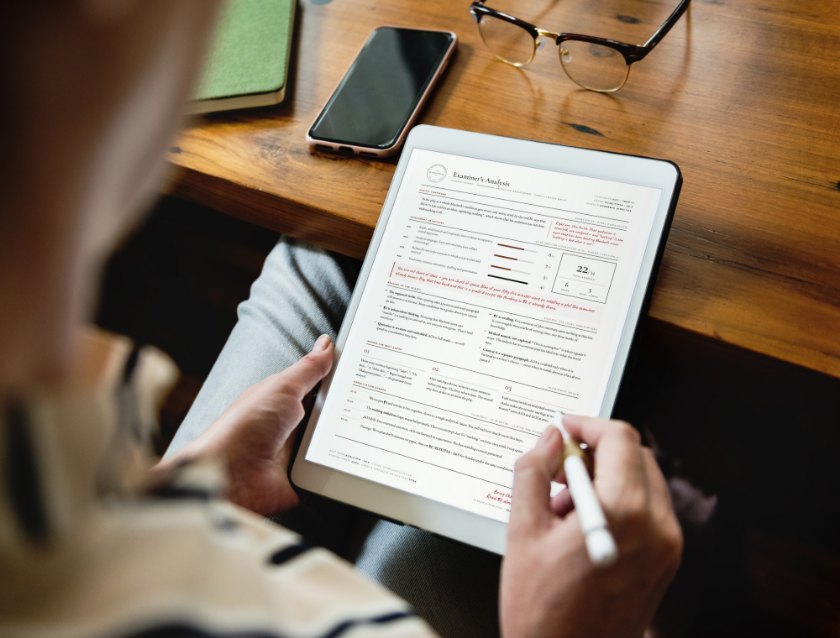
By hand on her iPad, against the published assessment objectives, band by band, every mark attributed to the place that earned it. Four things come back: the marked paper as a PDF, a written analysis question by question, a personalised learning plan with objectives, and an answer to the essay questions that would have taken top marks. All of it yours to keep indefinitely.
-
07
If you chose the one-to-one hour: an hour and a half with Leah
A booking link comes with the marked paper and the analysis, and the student chooses the time. One to one on Google Meet with the script on a shared screen — not a reading-out of the breakdown they already have, but the two or three things that cost the marks and what to do about them.
What it is not
A mark on one paper is not a prediction, and we will not pretend otherwise.
The script comes back with a mark and the band it falls in, because that is what marking against a mark scheme produces. It is a measurement of one paper, sat once. It is not a predicted grade, it carries no weight with a school or a board, and it is not teaching. It is also not a coursework service: the paper is sat unaided, and no part of what comes back may be handed in anywhere as the student’s own work.
Who it is for
Usually a student who is working hard and cannot see where the marks are going.
Before mocks, or after
As a rehearsal under real conditions, or to find out why a school mock came back lower than the exercise book suggested.
A second opinion
Where a grade is disputed or unexplained, an independent script marked against the same published criteria is a straight answer.
Timed conditions
Some students know the material and lose it in the room. That shows up in a timed paper and nowhere else.
Not, generally, a student in difficulty
If the material has not been learned, a paper says so at length and expensively. Teaching first is the honest order.
Subjects and boards
English Language, English Literature, French and Spanish — the four subjects taught here, at GCSE or A-Level, on any of the major boards.
AQA, Pearson Edexcel, Eduqas, OCR and Cambridge IGCSE. The board matters: the assessment objectives differ between them, and a paper written to the wrong one measures the wrong thing. It is asked for at the point of booking for that reason.
One paper covers one subject at one level. English Language, English Literature, French and Spanish each have a page setting out what the specification asks for.

Leah. French & Spanish, St Edmund Hall, Oxford.
Who writes it and marks it
Mrs Leah Burgess, and nobody else.
She read French and Spanish at St Edmund Hall, Oxford, has tutored one to one for seven years and more, and has worked under contract for schools. She writes the paper, she marks it, and she takes the hour. No pool of associates, nothing farmed out, nothing machine-marked.
Enhanced DBS · Designated safeguarding lead · More about Leah
Afterwards
What happens once the marking is back.
Yours to keep
The paper, the marked script, the analysis, the learning plan and the model answer are yours for good. Nothing to log into, nothing to renew.
Questions are answered
If a comment in the analysis is not clear, write and ask. Explaining our own marking is never charged for.
A plan to work from
Objectives to work to between now and the examination, written for this student — useful whether or not anything else is ever booked here.
One person to write to
William handles everything that is not teaching and answers himself. Nobody here works on commission and nobody will chase you.
If a consultation leads somewhere, it leads to teaching in English Literature, English Language, Spanish or French, or to Oxbridge admissions coaching. None of it is pushed, and the assessment is worth having on its own.
Questions
What parents ask before they book.
What if the paper is not what we agreed?
You may cancel for a full refund at any time before the paper is sent. If the paper we send does not follow the plan you approved, we rewrite it once at no charge — measured against the plan rather than against the mark your child goes on to be awarded. We do not promise a grade, here or anywhere else.
Who writes it, and who marks it?
Leah, both, every time. If she cannot write a paper in the time promised, we say so before you pay rather than hand it to somebody else.
Is it a past paper?
No. A past paper tests whatever it happened to test the year it was set. This is written against your child’s board, their subject and their set texts, aimed at the examinations they are actually sitting.
Can we speak to somebody before paying?
Yes. Write to admissions and William answers. There is no sales call, and nobody here works on commission.
What happens to my child’s work?
It is marked by Leah and shown to nobody. No student’s work appears anywhere without written permission from a parent; the specimens here were written by Leah.
Does anything renew?
No. It is bought once. We never see or hold a card number, nothing recurs, and there is no account to close.
Anything not answered here: write to us before you book rather than after.
Booking
One short form, and everything above follows from it.
One form, and it is short. The subject, the level, the exam board, and a few lines on what the paper should lean on — the topics they are shakiest on, or the question type that keeps costing them marks. That last part is what makes the paper theirs rather than generic, so it is worth two minutes.
Payment is taken by Stripe on the screen after this one, and the card details never touch this site. We write to you about the plan for the assessment normally within 24 hours, and the paper itself takes two to three days. It arrives by email with the guidance pack for sitting it, ready to print or to sit on screen. Once the script comes back, the marking and the written analysis follow within 48 hours. Cancellation is set out in our terms.